NEWS
WORKSHOP
MAKESHIFT
05.2026
MAKESHIFT
05.2026

Greg co-hosted a “threatcasting” workshop at the inaugural MakeShift conference in New York with inCitu’s Nick Kaufmann, challenging participants to imagine the future of privacy, surveillance, and microtargeting. Once teams had created Black Mirror-style mad libs, Nick reproduced their stories in XR using inCitu’s platform, literally embedding potential future in Manhattan’s street grid.
This was effectively the kickoff of Greg’s appointment as a 2026–2027 urbanist-in-residence at the University of Toronto’s School of Cities, which will build off his landmark report, The Augmented City on behalf of Cornell Tech. Watch this space for more.
Watch “Surface Tensions:
Threatcasting the Augmented City”
KEYNOTE
GRUPO AG
05.2026
GRUPO AG
05.2026

Greg made a side quest to Guatemala at the behest of Grupo AG, one of Latin America’s leading steel- and circular materials companies and the largest recycler in Central America.
Invited to speak at a dinner honoring dozens of local construction and real estate firms for their for use of “living steel,” he did his best to connect the dots between Guatemala's unique demographics as both a relatively young and still-urbanizing nation, the next generations’ real estate needs, desires, and spaces, the mounting climate catastrophes facing the nation, and how the construction industry must evolve to meet all of these challenges.
While he was in Guatemala, Greg sat for an interview with news site La Hora on the future of cities. Link below.
Watch Greg’s interview
KEYNOTE
EVENTS INDUSTRY COUNCIL
05.2026
EVENTS INDUSTRY COUNCIL
05.2026

What do stars, cities, and business events have in common? Each is a fusion reactor of sorts, alternately producing heat and light, or new ideas and connections. That was Greg’s message to the Events Industry Council — the voice of the business events industry on advocacy, research, professional recognition, and standards — in Washington on Global Meetings Industry Day on May 6.
Face-to-face meetings are essential to both business and society, but AI alternately threatens to disrupt (or promises to enhance) it depending on what we value — which more than anything else, is simple connection.
Watch Greg’s keynote
PODCAST
WTF4C
04.2026
WTF4C
04.2026

We need to do a better job at building places we love, otherwise we will just discard them.
Greg joined Dr. Fanni Melles on her long-running podcast (427 episodes and counting!) What Is The Future For Cities? (WTF4C) to discuss climate adaptation and reuse, cities and serendipity, and much, much more, as he always does.
Listen to the podcast
KEYNOTE
MID-OHIO REGIONAL
PLANNING COMMISSION
03.2026
MID-OHIO REGIONAL
PLANNING COMMISSION
03.2026

We’re playing SimCity for real. That was Greg’s message at the Mid-Ohio Regional Planning Commission’s annual State of the Region summit in Columbus to nearly 900 local civic leaders. The game that radicalized a generation of accidental urbanists has been reborn as AI-powered digital twins, generative cities spun up in real time, and AR overlays — the latter of which helped pass Columbus’s 2024 LinkUS transit referendum. But as machine intelligence scales, being together face-to-face becomes even more valuable, not less.
Following the keynote, Greg joined MORPC’s chief strategy officer Joseph Garrity on the Growing Better Together podcast for a wider-ranging conversation on cities and scaling laws, the loneliness epidemic, and what Columbus might learn from Tulsa Remote.
Watch Greg’s keynote
Listen to the podcast
MODERATING
SXSW
03.2026
SXSW
03.2026

Greg returned to Austin for the third year running to attend South by Southwest, this time to host “Seeing is Believing” — a main program panel hosted by inCitu at the intersection of XR, urban planning, and climate resilience — and to once again host sessions at the Fast Company Grill and its sister venue, Inc. Founder’s House.
Sessions at the former included the future of travel (pictured) — how can tech help us be present in the presence of others? — and the mainstreaming of crypto. (🧐️) Over at Inc., he hosted a discussion on sustainability certification and tracing in the age of agentic commerce. (Not pictured: a weekend of scooter rides, robotaxi rides, breakfast tacos, and frozen margs.)
Watch “Seeing is Believing”
Read/Watch the future of travel
Read/Watch sustainability certification
Read/Watch the mainstreaming of crypto?
PODCAST
UNFROZEN
03.2026
UNFROZEN
03.2026

Greg and his “Unfrozen” podcast co-host Daniel Safarik continued their second century of episodes, including a live report from Dan’s mid-century birthday celebration, along with home-grown cities, the death and life and hoped-for rebirth of gentrification, and Pulitzer Prize-winning architecture critic Paul Goldberger on President Trump’s designs on Washington... and beyond.
Listen to episodes:
No. 116 – The Desert of the Real
No. 117 – The Death and Life of Gentrification
No. 119 – Mussolini’s Ballroom
KEYNOTE
URBAN
LAND INSTITUTE
02.2026
URBAN
LAND INSTITUTE
02.2026
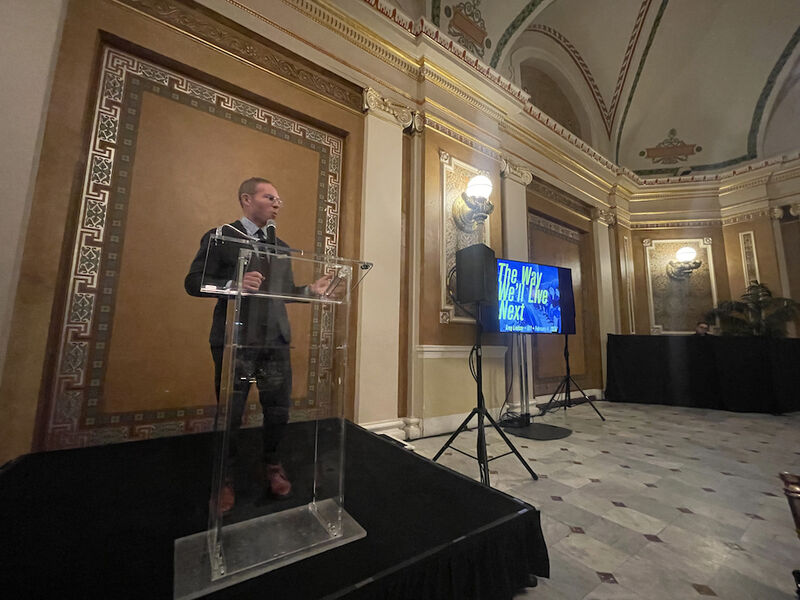
Like many, Greg has marveled at the Urban Land Institute’s transformation from a real estate industry association into an inspiring force for change through its interdisciplinary technical assistance and advisory programs. So, he jumped at the chance to speak to ULI’s Global Governing Trustees in Washington about what ULI could become, thanks to CEO Angela Cain’s ambitious “Futurescape 2035” campaign.
Invited to speak briefly about the trends shaping the built environment over the next decade, Greg settled on two—Big Tech’s overweening desire to divide and conquer us, and the shock(s) of climate change. Both challenges demand new forms of civic- and social infrastructure as well as the physical kind, and he hopes ULI members will have a strong role to play in that as well.
He’ll revisit this theme in his closing keynote at the ULI Florida Summit at the end of February.
WORK ARCHIVE
GREG LINDSAY
GREG
ABOUT
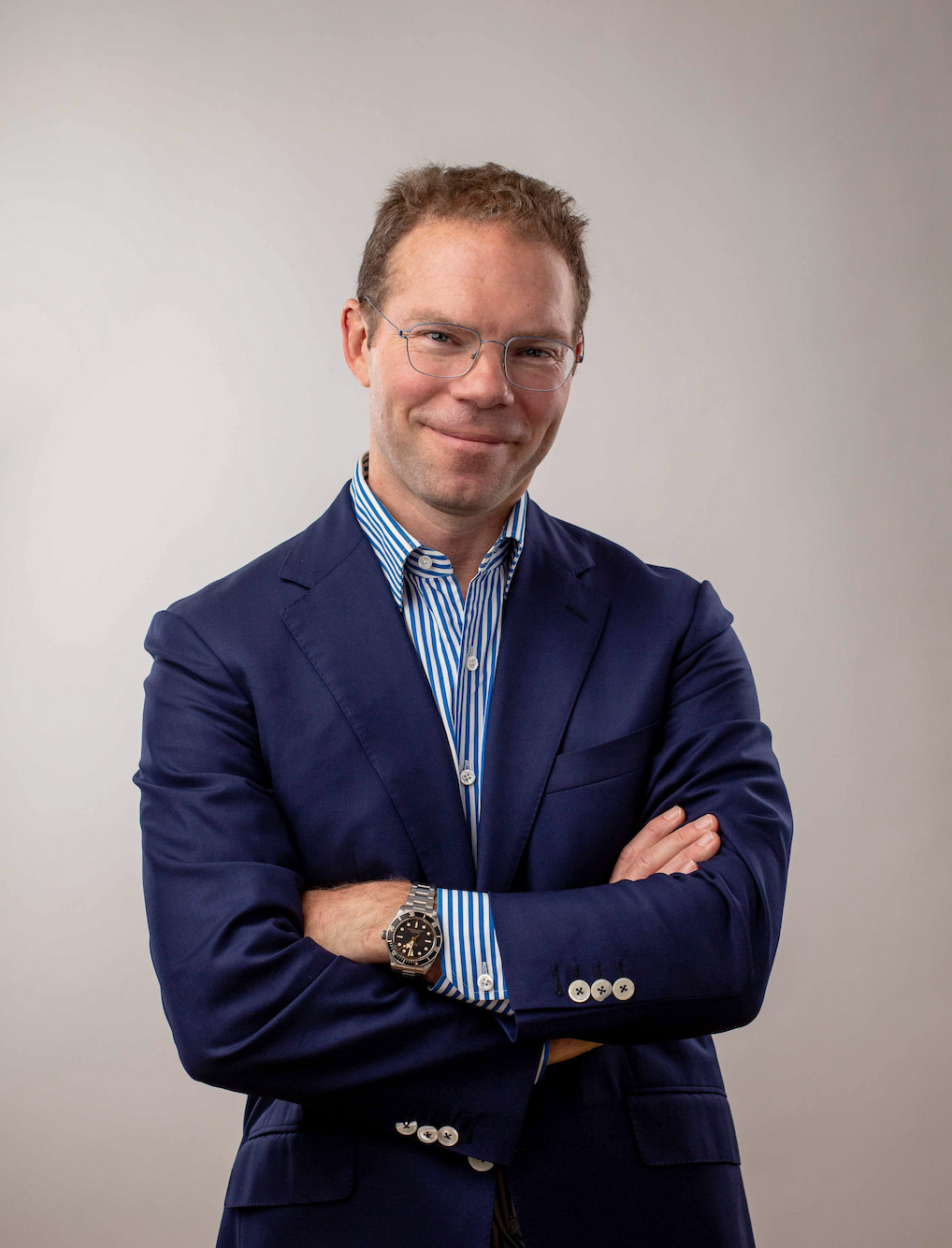
Greg Lindsay is a generalist, urbanist, futurist, and speaker
He is presently a 2026–2027 urbanist-in-residence at the University of Toronto’s School of Cities, as well as a non-resident senior fellow of MIT’s Future Urban Collectives Lab, Arizona State University’s Threatcasting Lab, and the Atlantic Council’s GeoStrategy Initiative. Previously, he was a 2022–23 urban tech fellow at Cornell Tech’s Jacobs Institute, where he explored the implications of AI and augmented reality at urban scale.
His past speaking engagements and events include the Venice Architecture Biennale, Aspen Ideas Festival, Civic I/O summit at SXSW, the Dubai Business Forum, the World Economic Forum, and La Conférence de Montréal, among others.
SPEAKING TOPICS
The way we’ll live next in a New/Post/Never-Normal world
Looking for a speaker who can help you and your organization make sense of the New/Post/Never-Normal? Greg Lindsay regularly speaks to some of the world’s most innovative organizations about the future of cities, climate, work, AI, and the future of the future itself. Below is a short list of his speaking topics, and here are the details. If any pique your interest, email him. After all, there’s no time to think about the future like the present.
Read more about topics
—
Topics
THE WAY WE’LL LIVE NEXT
The built world implications of our
never-normal landscape.
AUTONOMOUS EVERYTHING
AI, the future, and what we
can do about it.
WHERE WILL YOU LIVE IN 2050?
Why and where a warming
world may still have shelter for us.
HOW TO WORK, TOGETHER
New forms of collaboration
in a world in which corporate silos
have cracked wide open.
WHERE THE ROBOT MEETS
THE ROAD
A future of things that drive and fly
and think for themselves.
ENGINEERING SERENDIPITY
How do we discover unknown
knowns — the things and people we
don’t know we know?
The built world implications of our
never-normal landscape.
AUTONOMOUS EVERYTHING
AI, the future, and what we
can do about it.
WHERE WILL YOU LIVE IN 2050?
Why and where a warming
world may still have shelter for us.
HOW TO WORK, TOGETHER
New forms of collaboration
in a world in which corporate silos
have cracked wide open.
WHERE THE ROBOT MEETS
THE ROAD
A future of things that drive and fly
and think for themselves.
ENGINEERING SERENDIPITY
How do we discover unknown
knowns — the things and people we
don’t know we know?
GREG’S
SPEAKING TOPICS